When we think of names, we usually think of a few syllables that fit comfortably on a driver’s license or a coffee cup. But for some, a name is more than just a label—it is a sprawling narrative, a tribute to ancestry, or a bold statement of individuality. As we move through 2026, the fascination with the “longest name in the world” remains high, blending historical trivia with the modern complexities of digital databases.
How long can a name actually get, and what happens when a name becomes too big for the systems meant to hold it? Let’s dive into the stories behind these linguistic marathons.
Historic Heavyweights
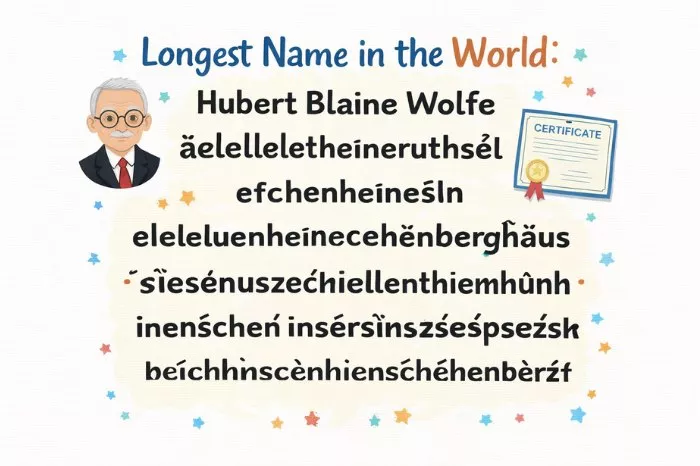
For decades, the name synonymous with “longest” belonged to a German-born typesetter who lived in Philadelphia. Hubert Blaine Wolfeschlegelsteinhausenbergerdorff Sr. (born 1914) held the official Guinness World Record for years.
His full surname consisted of 585 letters, a dizzying combination of words that told a story of a sheep-herder, his house, and his ancestors. While he eventually shortened it to “Hubert Blaine” for daily use, his original name remains a legendary benchmark in the world of onomastics (the study of names).
Modern Record-Breakers
In more recent years, the records have shifted toward “given names” rather than surnames. One famous case involved a woman in Texas, born in the 1980s, whose father gave her a first name containing 1,019 letters. Her birth certificate was nearly two feet long.
However, by 2026, many countries have begun implementing stricter naming laws to prevent “unusable” names. While the records of the past are grandfathered in, modern parents often face character limits at the registry office. In the UK and parts of the US, you might have more freedom, but in many European countries, the government can—and will—reject a name that they deem detrimental to the child’s well-being or simply too long to process.
“Digital Ceiling”: Why Length Matters in 2026
While having a 1,000-letter name is a fascinating conversation starter, the practical reality in 2026 is a logistical nightmare. We live in a world governed by databases, and those databases have “character limits.”
- Airline Systems: Most airline booking systems truncate names after 27 to 30 characters.
- Government IDs: Passports and Social Security cards have physical space constraints. If your name is a paragraph long, it will inevitably be chopped into an unrecognizable string of initials.
- Social Media: Platforms like X (formerly Twitter) or Instagram have strict character counts for display names, making it impossible for record-holders to use their full legal identity online.
For many people with exceptionally long traditional names—common in some African, South Asian, and Hawaiian cultures—this “digital ceiling” is a source of genuine frustration, often requiring them to legally shorten a name that carries deep cultural meaning.
Culture vs. Character Counts
It is important to distinguish between “stunt names” (names created specifically to break a record) and “cultural names.” In many cultures, a name isn’t just a first and last; it includes a lineage.
In certain South Indian traditions, a name might include a father’s name, a grandfather’s name, a village name, and a caste name. Similarly, in Hawaiian culture, some names are composed of poetic phrases that describe the circumstances of a child’s birth. To the Western eye, these might look like the “longest names in the world,” but to the families, every syllable is a vital link to their history.
The 2026 Perspective on Naming Limits
As we look at naming trends this year, we see a push-back against “stunt naming.” While the internet loves a viral story about a 1,000-letter name, modern society is trending toward meaningful brevity.
Parents are realizing that a name is a tool. If the tool is too heavy to carry—meaning the child can’t spell it by age seven or it breaks every website they try to sign up for—it may be more of a burden than a gift.
Practical Advice for the “Length-Curious”
If you are considering a long or hyphenated name for a child or a brand in 2026, keep these human-friendly tips in mind:
- Check the “Form Factor”: Does the name fit on a standard credit card?
- Rethink the Hyphen: Double-hyphenated last names (e.g., Smith-Jones-Miller-Davis) are becoming more common, but they often cause errors in medical and insurance software.
- Middle Name Safety Valve: If you have a long family name you want to honor, the middle name slot is the safest place for it. It stays on the record without complicating daily life.
A Name is a Story
Whether it’s 3 letters or 300, a name is the first chapter of a person’s story. The “longest names in the world” remind us that language is flexible and that humans have an innate desire to be unique. However, as our lives become increasingly digital, the most “practical” name might just be the one that fits comfortably in both a heart and a database.
Leave a Reply